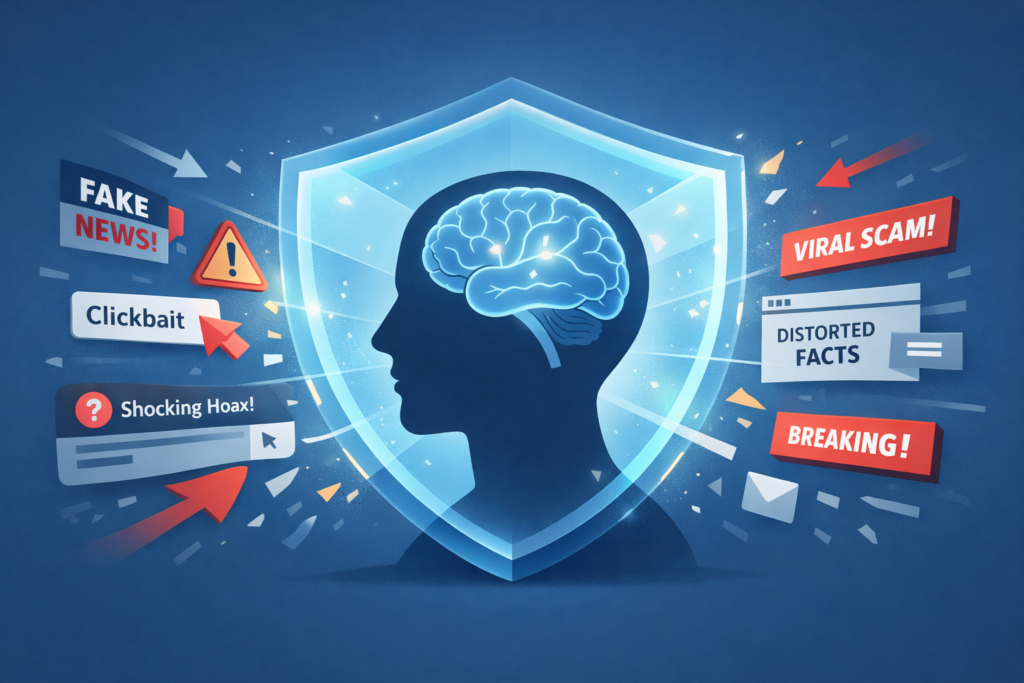
In today’s world, information became easily accessible. With a single click or scroll, students can access more content than entire generations before them encountered in a lifetime. News, opinions, images, videos, research papers, advertisements, and artificial intelligence–generated content are constantly competing for attention. While this access is empowering, it also comes with a hidden danger: misinformation, manipulation, and digital overload.
This is why digital literacy has evolved beyond knowing how to use technology. Today, it is a form of defense — and at its core lies one essential ability: critical thinking. In a rapidly changing landscape driven by algorithms and artificial intelligence, critical thinking has become the new must-have skill for students and lifelong learners alike.
What is digital literacy?
Digital literacy is no longer just about knowing how to use a computer, send an email, or create a document. Digital literacy includes:
- The ability to evaluate the credibility of sources: checking the author and organization, examining the source domain, checking comments and reviews and looking for evidence.
- Understanding how algorithms influence what we see online.
- Recognizing bias, manipulation, fake content and fake accounts: analyzing the language used, checking the profile or page, cross-checking facts.
- Protecting personal data and respecting digital privacy: limiting what you share online, using strong and unique passwords, turning on two-factor authentication (2FA), avoiding suspicious links and downloads, understanding privacy settings, respecting other people’s privacy.
- Understanding how AI-generated content works: recognizing common signs of AI-generated content, learning the basics of AI, comparing AI-generated content with human-made, understanding the danger of deepfakes, staying updated on AI regulations and ethics.
- Digital etiquette: being aware of our actions, communicating responsibly in digital spaces, understanding how particular images, messages and comments can affect other people. This involves staying away from hate speech, bullying, and offensive language.
In short, digital literacy is about thinking before clicking, sharing, commenting, or believing.
And that is exactly where critical thinking becomes essential.
Why critical thinking matters more than ever
Critical thinking is the ability to analyze information logically, question assumptions, and make reasoned judgments. It is the difference between reacting emotionally to a viral post and pausing to ask:
- Who created this content?
- What is their intention?
- Is there evidence to support this claim?
- Is this fact, opinion, or manipulation?
- Are there alternative perspectives?
In a world that rewards speed and instant reactions, critical thinking asks us to slow down and think deeper. This simple pause can protect us from falling into online traps such as:
- Fake news
- Deepfakes and AI-generated deception
- Online scams
- Propaganda
- Toxic comparison culture on social media
Students who develop critical thinking skills are better equipped not only for academic success but also for navigating real life in a digital society.
Digital threats students are facing today
Modern students are exposed to challenges that did not exist in previous decades. Some of the most pressing digital threats include:
- Misinformation and fake news
Anyone can publish content online, and not all of it is true. Without critical thinking, it is easy to accept false narratives as facts.
- AI-generated content
With AI tools becoming more advanced, fake images, videos, voices, and texts can look and sound real. The line between reality and artificial creation is blurring.
- Algorithm manipulation
Social media platforms show content based on engagement, not truth. Algorithms often push extreme or emotional material to keep users online longer.
- Mental health impact
Constant exposure to edited realities can lead to anxiety, low self-esteem, and unhealthy comparison. - Privacy risks
Many students overshare personal information without understanding long-term consequences.
Critical thinking helps students recognize these risks and respond wisely instead of impulsively.
Education must change its focus
Traditional education has emphasized memorization for many years. But in the digital age, information is unlimited — thinking skills are not. The educators as well as person her/himself should place a stronger focus on:
- Media literacy education
- Debate and discussion
- Problem-solving exercises
- Source evaluation tasks
- Ethical use of AI
- Reflection and questioning
Instead of asking, “What is the correct answer?” it is better to ask:
- “How did you reach that conclusion?”
- “What sources support your viewpoint?”
- “What might be missing from this perspective?”
This approach prepares students not just for exams, but for real-world decision-making.
How students can strengthen their critical thinking today
The good news is that critical thinking is a skill that can be trained and improved. Here are simple but powerful habits students can start practicing:
- Question the source – Always check who is behind the information
- Cross-check facts – Look for multiple reliable sources
- Recognize emotional manipulation – Strong emotions often equal low credibility
- Understand bias – Everyone has one, including media platforms
- Take pauses – Avoid immediate reactions and ask why
- Limit passive scrolling – Choose active learning instead
- Practice reflection – Ask yourself what you learned and why it matters
These habits form a strong mental filter — one that allows students to move through digital spaces with intelligence and confidence.
Critical thinking as a life skill, not just an academic one
Beyond education, critical thinking directly impacts:
- Career decisions
- Personal relationships
- Financial choices
- Health and wellbeing
Employers today value people who can think independently, analyze situations quickly, and solve problems creatively. In fact, critical thinking is now one of the top skills listed by global employers for the future workforce.
If you want to develop new skills, you should explore the online courses available on okajak.com.
Conclusion: Knowledge is power, but thinking is protection
In the digital world, information is power — but only if it is understood and questioned. Digital literacy is not just about keeping up with technology; it is about defending the mind in an age of distraction and deception.
Critical thinking is the tool of the modern student. It is the key to clarity in confusion, truth in chaos, and empowerment in a world driven by data.
Sources:
https://karnavatiuniversity.edu.in/the-importance-of-critical-thinking-in-the-digital-age/
Courses:
https://okajak.com/en/category/online-courses/