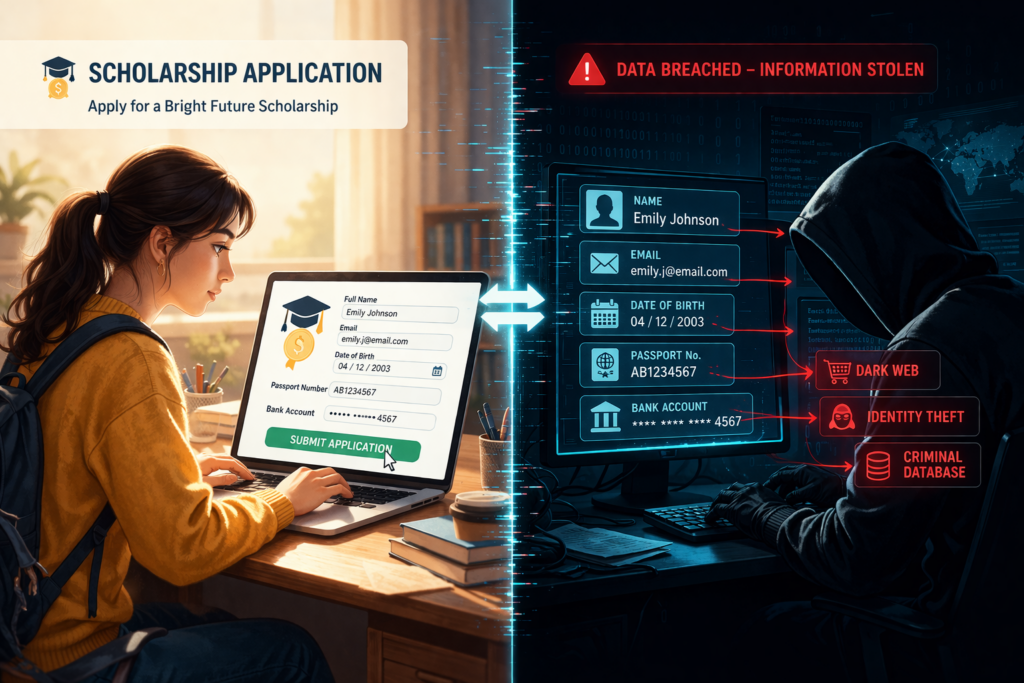
In recent years, scholarships have become one of the most important financial resources for students seeking access to higher education. At the same time, the growing number of online scholarship platforms and application portals has created new opportunities for cybercriminals. Among the emerging threats is scholarship data harvesting—a form of online fraud in which scammers collect students’ personal information through fake scholarship applications.
While many students associate scholarship scams primarily with financial fraud, the theft of personal data has become an equally serious risk. Fake scholarship websites, phishing emails, and fraudulent application forms are increasingly used to collect sensitive personal information that can later be exploited for identity theft, financial fraud, or illegal resale on data markets.
This article examines how scholarship data harvesting works, why cybercriminals target students’ personal data, and what practical steps students can take to protect themselves.
The growing problem of data harvesting in scholarship applications
Applying for scholarships often requires students to provide extensive personal information. Typical applications may request:
- full name and contact details
- date of birth
- academic records and transcripts
- identification documents
- financial information
- essays, CVs, and recommendation letters
While legitimate scholarship providers require certain information in order to evaluate candidates, scammers exploit this expectation. Fraudulent scholarship portals are often designed to closely imitate legitimate organizations and persuade students to submit personal data under the promise of financial support.
These websites may appear professional and trustworthy, using institutional language, official-looking logos, and fabricated testimonials from previous “recipients.” However, their primary objective is not to award scholarships but to collect sensitive information from applicants. In many cases, victims do not immediately realize that they have been targeted.
Why cybercriminals collect students’ personal data
One important question students often ask is why scammers are interested in personal information obtained through scholarship applications. In reality, personal data has significant value and can be used in several forms of cybercrime.
One of the most common uses of stolen personal information is identity theft. When cybercriminals obtain data such as a person’s full name, date of birth, address, or identification number, they may use this information to impersonate the victim. This can allow criminals to open bank accounts, apply for loans, or create fraudulent online profiles under another person’s identity.
In addition, personal information collected through fake scholarship portals is often sold on illegal online marketplaces. Large datasets containing email addresses, phone numbers, and identification documents can be purchased by other cybercriminals who use them for phishing campaigns or identity-related crimes.
Finally, detailed personal data allows scammers to conduct targeted social engineering attacks. If criminals know a student’s university, field of study, or scholarship interests, they can send highly personalized messages pretending to represent legitimate institutions. Because these messages include real personal details, they are often more convincing and difficult to detect.
For these reasons, personal data obtained through fraudulent scholarship applications can become a valuable resource for cybercriminal networks.
A Real-Life Example: When Personal Data Leads to Financial Fraud
Real-world cases demonstrate how dangerous scholarship-related data harvesting can be. In 2025, students at Jagannath University in Bangladesh reported a scam in which cybercriminals used leaked student information to contact them with offers of a “merit scholarship.”
The scammers already possessed specific details about the students, including their names, departments, and academic year. By referencing this information, they created the impression that the scholarship offer was legitimate. During phone calls, victims were asked to provide bank account details and verification codes in order to “receive the scholarship payment.”
One student reported that after sharing his banking information, the scammers immediately withdrew money from his account. Other students avoided the same outcome only after becoming suspicious of the requests.
This case highlights an important pattern in modern cybercrime: stolen personal data can be reused to create more convincing scams. Once students submit their information through fake scholarship forms, it may later be used to impersonate legitimate institutions or to conduct targeted fraud.
Practical steps to protect yourself from scholarship data harvesting
Although scholarship scams are becoming increasingly sophisticated, students can reduce their risk by following several practical precautions.
Verify the scholarship provider
Before submitting any application, students should confirm that the scholarship is offered by a legitimate organization. This can be done by checking the official website of a university, government institution, or recognized foundation.
Be careful with personal information
Students should avoid sharing highly sensitive information—such as passport numbers, national identification numbers, or banking details—during the early stages of an application. Legitimate scholarship providers rarely request financial information before the final stages of selection.
Examine website security
Fraudulent websites often lack basic security features. Students should check whether the website uses HTTPS encryption, provides verifiable contact details, and belongs to a credible organization.
Be skeptical of unrealistic offers
Scholarships that promise guaranteed funding or immediate selection should be approached with caution. Legitimate scholarship programs typically involve competitive selection processes.
Use trusted scholarship sources
Students should prioritize scholarship opportunities recommended by universities, academic advisors, or official government scholarship portals. Relying on trusted sources significantly reduces the risk of encountering fraudulent platforms.
In conclusion, scholarship data harvesting represents a growing threat in the digital education environment. As more students rely on online platforms to search for financial support, cybercriminals increasingly exploit scholarship applications as a means of collecting valuable personal information.
The consequences of such scams extend beyond financial loss. Stolen personal data may enable identity theft, targeted phishing, and long-term security risks for victims. For this reason, developing digital awareness and carefully evaluating online opportunities is essential for students navigating the modern scholarship landscape.
If you are interested in learning more about online fraud targeting students, we also recommend reading our Okajak article “The Rise of AI-Generated Misinformation in Scholarships,” which explores how emerging technologies are being used to manipulate scholarship information and mislead applicants.
https://www.wiu.edu/student_success/financial_aid/pdf/ScholarshipScams.pdf
https://scholarship.unm.edu/Resources/scams.html?utm_source
https://www.idstrong.com/sentinel/scholarship-scams/
Our article: The Rise of AI-Generated Misinformation in Scholarships
Our website: https://okajak.com/en/about-us/